
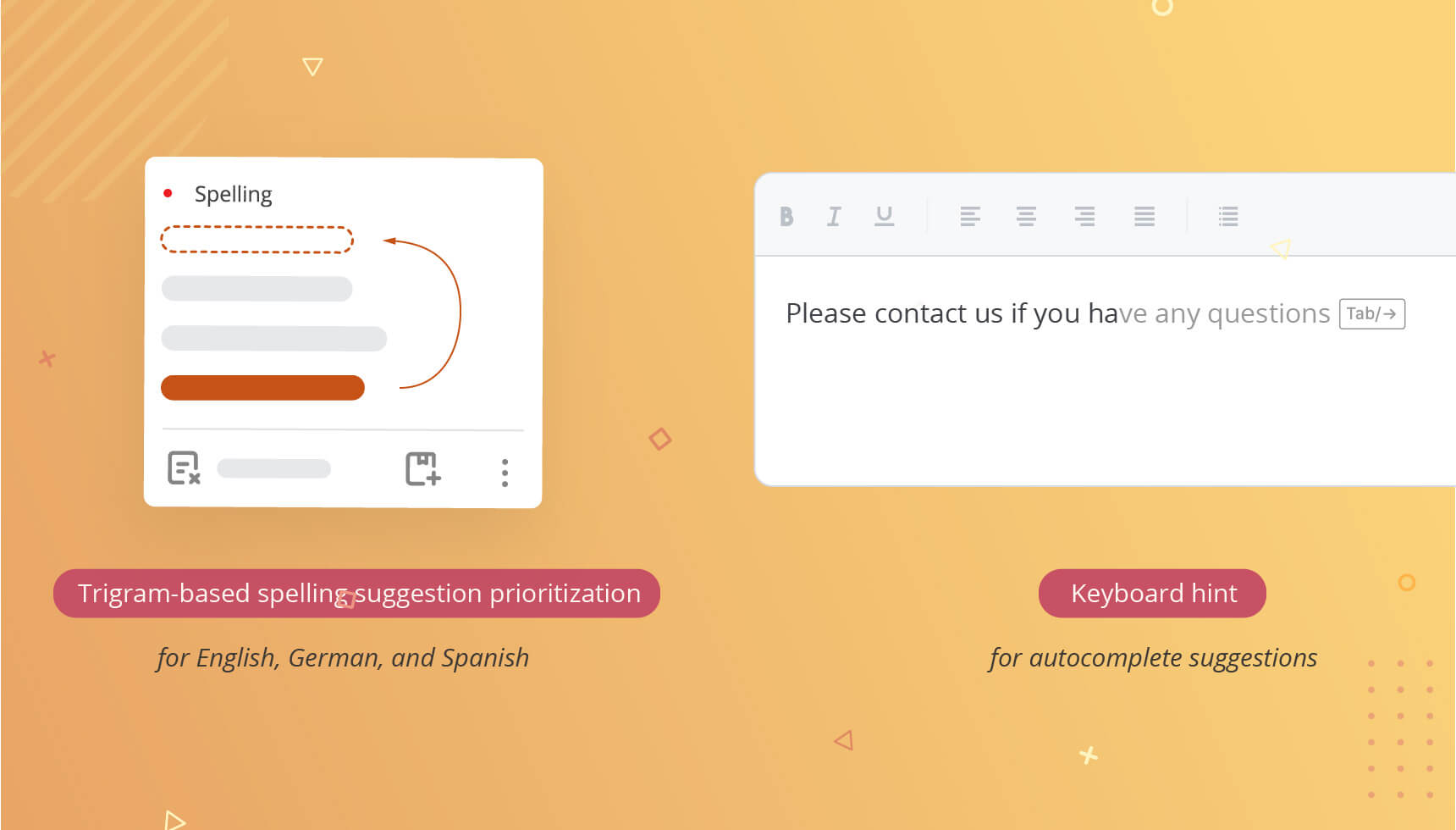
WProofreader v6.10.0 introduces a major upgrade to spelling suggestion ranking with trigram-based n-gram prioritization for English, German, and Spanish, adds autocomplete keyboard hints, updates the grammar engine, expands language support with Greek and Czech resources, and patches a security vulnerability.
Check the TL;DR below.
📝 TL;DR
- New trigram-based spelling suggestion prioritization for English, German, and Spanish — the correct suggestion now ranks first ~80% of the time, up from ~62% without prioritization
- Expanded dictionaries with 2,000+ new entries and 600+ medical terms across multiple languages
- Autocomplete suggestions now show a keyboard hint (Tab / →) for accepting completions
- 80+ new English style rules addressing profanity, slurs, and inclusive language
- Improved AI proofreading reliability by disabling 15 problematic rules across English, German, and Spanish
- Added Greek and Czech language resources; updated Czech Hunspell dictionary
- AI writing assistant disclaimer localized for Danish and Norwegian
- Security fix. Updated lucene-core to address PRISMA-2021-0081
🛠 Enhancements
WProofreader JS core (v3.38.6019)
- Added a keyboard hint next to autocomplete suggestions that shows how to accept them (Tab / →). The hint is visible wherever autocomplete suggestions are shown.
- Added “Powered by WProofreader” branding to the suggestion pop-up for the browser extension, WordPress plugin, and Drupal integration.
- Redesigned the promotional banner in the free SCAYT plugin for CKEditor 4. The banner is now smaller and less intrusive, with a link to the website for more details.
✨ AI writing assistant
- Localized the AI disclaimer for Danish and Norwegian.
📚 Spelling engine
- Introduced trigram-based n-gram suggestion prioritization for English, German, and Spanish. This replaces the previous bigram-based approach and improves the accuracy of spelling suggestions by considering three-word sequences instead of two. When multiple spelling candidates are equally plausible — e.g., store, shore, stare — the model uses surrounding context to rank the most relevant suggestion higher. In benchmarks on American English, the correct suggestion now ranks first approximately 80% of the time, compared to 71% with the previous approach. Each language model requires approximately 100 MB of RAM. Currently, only suggestions from the main algorithmic spelling engine are reordered by the n-gram model.
- Expanded dictionaries with 2,000+ new entries across multiple languages (including English, German, Spanish, Ukrainian, Danish, Portuguese and Finnish). This covers a broad spectrum of categories: abbreviations (shortened forms), affixes, biology, business, chemistry, common terms, culinary, dialectal variations, legal, locations, neologisms, proper names, religion, science, slang, sport, and technology.
- Refined word lists by removing invalid dialectal entries, nonexistent words generated by compounding mechanisms, and incorrect casing.
- Enhanced medical terminology across English, Spanish, and German with 600+ new entries covering medical abbreviations, adjectives, disease names, and measurements.
- Optimized split patterns by adding 20+ rules for common words, adverbs, and conjunctions to prevent incorrect word splitting, while removing outdated or less restrictive patterns.
- Improved suggestion quality by excluding offensive terms in certain contexts and removing company names that overlap with common English words.
⚙️ Grammar engine
- Updated the third-party grammar engine, LanguageTool, to version 2026-02-13 with improvements across multiple languages.
- Portuguese. Extensive updates including new academic and formal style rules, improved handling of agreement, contractions, homonyms, and commas, disambiguation refinements for rare verbs and part-of-speech tagging, and numerous false-positive reductions. Portuguese (Portugal) received additional style improvements for foreign words, gerund avoidance, and vocabulary corrections.
- Catalan. New grammar rules, significant dictionary expansion, case checking improvements, and refinements to previously disabled rules. Enhanced specific rules such as ESCOLTAR_SENTIR and RESPONDRE_A.
- Spanish. Improved sentence tokenizer accuracy, added antipatterns for agreement, accent, date, and month rules, and enhanced medical-context language support with new medical terms.
- English. Maintenance-oriented improvements including rule precision fixes, match position corrections, case sensitivity adjustments, and prevention of incorrect word synthesis.
- German. Incremental rule improvements and refinements.
- Ukrainian. Dictionary update, tokenization improvements, and a new grammar rule.
💡 Autocorrect
- Refined prioritization rules for 120+ common misspellings across English, German, Spanish, Ukrainian, French, and Portuguese.
- Enhanced correction logic by removing 360+ invalid autocorrect entries for Spanish, specifically targeting incorrect suggestions and capitalized forms that were previously triggered by mistake.
📝 Style
- Updated style rules for English with 80+ new rules addressing strong profanity, slurs, and language related to race, ethnicity, gender, and ableism.
🤖 AI proofreading
- Improved AI engine reliability by disabling 15 problematic rules that caused logic loops, pattern shifting, and nonexistent word suggestions across English, German, and Spanish.
- Resolved bugs where the AI would incorrectly flag unknown proper names or offer shifted suggestions.
🌐 Languages
- Added new language resources for Greek, including disabled problematic grammar rules for unpaired brackets. Added new Czech language resources with spelling prioritization.
- Updated Czech Hunspell dictionary. Source: Czech CC0 dictionaries by Štěpán Škorpil.
Application server
- Updated third-party libraries:
- TensorFlow from 2.11 to 2.18 (Linux and Windows)
- rust_swig from 0.4.0 to 0.10.0
- tokenizers from 0.15.1 to 0.22.2
🛡 Security
- Updated the vulnerable lucene-core library used by the grammar engine to address PRISMA-2021-0081.